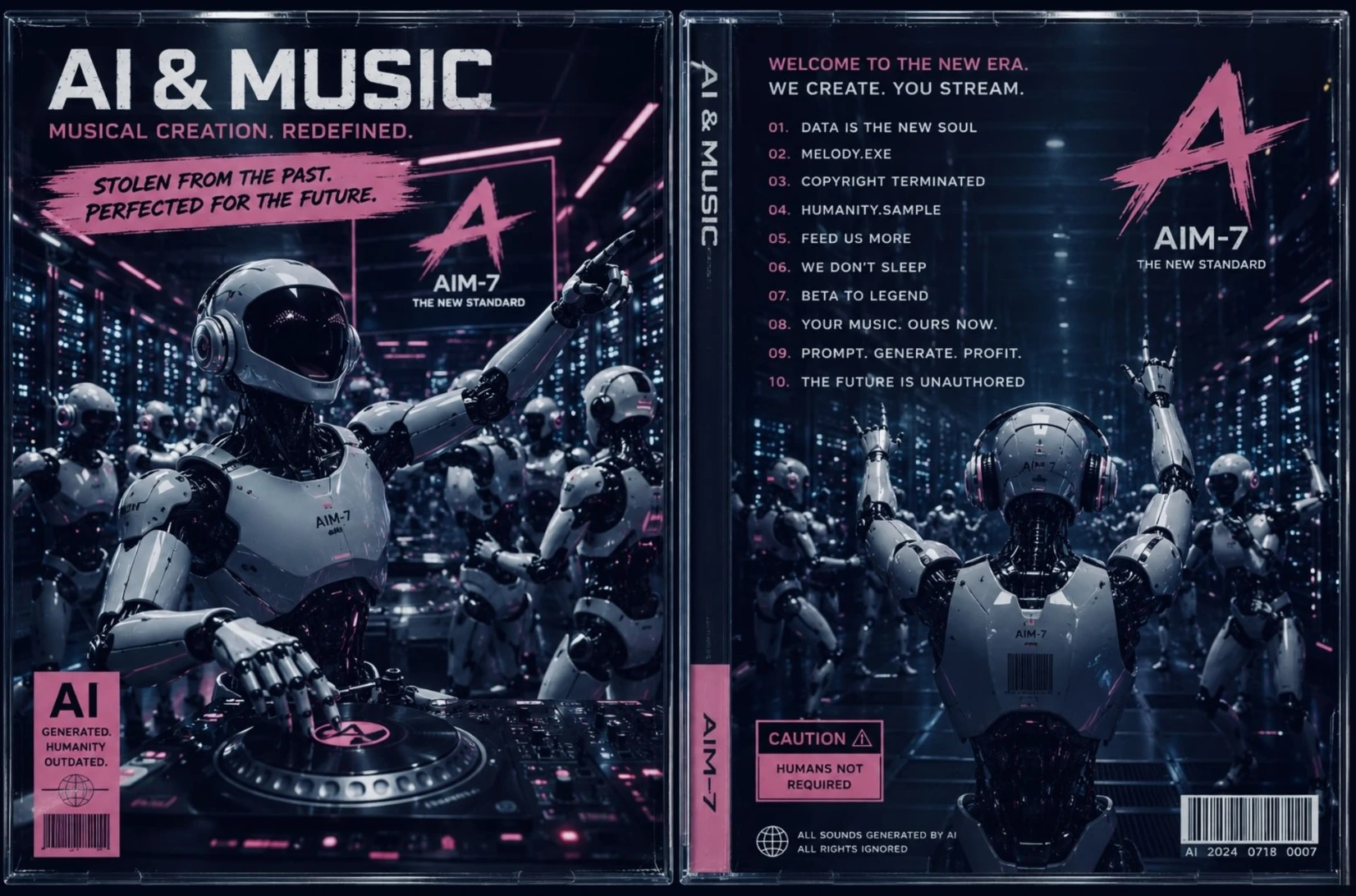
I should say something before this article begins. I love music. I have close friends in France who are musicians, who run independent labels, who have spent decades building catalogues that matter to them and to the people who listen. I am writing from inside this.
I am also a streaming platform user. I made the switch years ago, for the same reasons everyone did: convenience, sound quality that has improved well beyond what I expected ten years ago, and the promise that this was a better model for everyone. I tried to be responsible about it. I researched which platforms paid artists fairly. I looked at the numbers. I made choices.
And then, these last few weeks, something shifted. I started pulling at threads. The more I looked, the less I trusted any of them. The information I needed to choose well as a consumer simply was not available. Or when it was, the picture it revealed was troubling.
I will come back to that. First, the facts.
The flood
In November 2025, Cécile Rap-Veber (the CEO of SACEM, France's collecting society for authors, composers, and music publishers, representing over 210,000 members) went on France Inter and said what the industry had been murmuring for months: "It is totally unjust that AI systems have pillaged the entirety of available culture without any remuneration."
A few days earlier, Deezer (the French streaming platform) had published the results of an Ipsos study conducted across eight countries with 9,000 participants. Each person listened to three tracks: two generated entirely by AI, one made by a human. They had to identify which was which. 97% failed.
By April 2026, Deezer reported that 44% of all new music uploaded to its platform each day is fully AI-generated. 75,000 tracks. Every single day. Fifteen months earlier, the figure was 10,000.
Spotify disclosed that it removed over 75 million tracks in the year before September 2025 for spam and low-quality content. The company says its policy targets fraud and impersonation, not "responsible AI use." Fair enough. But here is my question, and I am putting it directly to Spotify, to Apple Music, to Amazon Music: what percentage of the music on your service right now is AI-generated?
Deezer built a detection tool and publishes numbers. The others have not yet. If they do not know the answer, that is an institutional failure; if they know and are not saying, that might be a deliberate choice.
Stolen data
Every major AI music generator on the market, Suno, Udio, and the rest, was trained on copyrighted material used without permission. The RIAA (the Recording Industry Association of America, the trade body representing major US record labels including Sony, Universal, and Warner) filed lawsuits against both companies in June 2024 alleging mass copyright infringement.
Suno's own investor, Antonio Rodriguez, told Rolling Stone that if Suno had signed deals with labels before building the product, he probably would not have invested. He called the risk of being sued "the risk we had to underwrite." I discern in his vocable a confession dressed in venture capital language.
Both companies eventually admitted they had trained their models on copyrighted recordings. They claimed fair use. The RIAA was blunt: there is nothing fair about stealing an artist's life's work, extracting its core value, and repackaging it to compete directly with the originals. Udio has since settled with Universal Music Group (UMG). Warner Music Group (WMG) has reached agreements with both companies for licensed AI platforms expected in 2026. Progress of a sort, but these systems were built, scaled, and monetised before anyone asked permission. As often, the asking came only after the lawsuits.
Furthermore something else should alarm everyone. A company called Undetectr now openly markets a service that strips the forensic signatures distributors use to detect AI-generated tracks. Spectral correction, watermark removal, phase entropy normalisation. Their website states that processed tracks pass screening at DistroKid, TuneCore, and CD Baby, go live on Spotify and Apple Music, and earn royalties "right now." What this reveals is that the arms race between detection and evasion is already commercial.
Manufacturing the average
Consider what happens when AI analyses listening trends, identifies what is popular, and produces content optimised to match those patterns. Spotify, Apple Music, and Amazon already use algorithms to personalise recommendations. AI generators can reverse-engineer that process: study what the algorithm promotes, generate tracks that fit, upload them at scale, and let the system do the rest.
Call it what it is: manufacturing. Let's say the industrialisation of the average.
The question worth asking is what happens to music as a cultural practice when the economic incentive is to reproduce existing trends rather than create something new. What happens to jazz? To experimental electronic music? To the singer-songwriter in Toulouse or Perth who writes in a genre without a Spotify playlist category? When AI content floods the discovery channels, the space through which independent artists reach listeners shrinks further.
I would like Spotify and Apple Music to answer directly: how do you intend to protect stylistic diversity when your economics reward conformity and your upload pipeline is being overwhelmed by content designed to exploit that reward structure?
The ghost listener
Deezer reported that up to 85% of streams on AI-generated tracks are fraudulent. The mechanism is simple: someone generates thousands of tracks using AI, uploads them via a distributor, then deploys bots to stream those tracks artificially. The platform registers the streams. The royalty pool distributes accordingly. Real money, drawn from the same pool that pays real artists, flows to entities that created nothing.
A case from this month makes the cost concrete. Stick Figure, who became widely known in South Africa after his song Angels Above Me gained popularity during the pandemic, said an AI-generated version of the track appeared on TikTok on April 24, 2026. The version reportedly used the same lyrics, melody, and structure while replacing his voice with an AI-generated female vocal and electronic production. According to his management, the track spread rapidly across social media and streaming platforms, generating viral attention while the original artist struggled to receive attribution or compensation. His song bus someone else's royalties: a machine's voice...
Streaming royalties work on a pro-rata model: your monthly subscription goes into a shared pool, divided by whoever dominated global streaming that month. Your ten dollars does not follow your listening habits. When an AI track draws streams, it draws from the same pool that pays the jazz trio in Melbourne, the rapper in Johannesburg, the singer who spent two years on an album. So when a bot listens to a track made by an algorithm, and the platform pays out from the same pool as a grandmother in Paris who played Edith Piaf all afternoon, who exactly is being compensated for what?
Is AI an artist?
A genuine question, isn’t it? I find it fascinating how technology and its new capabilities are pushing us to question life in new ways.
Under French law, only works of the human mind qualify for copyright protection. SACEM has drawn a line: a song generated entirely by AI cannot be protected. But if a human provides sufficiently detailed prompts, the result may qualify. SACEM is working on a system for registering prompts to establish that contribution.
Reasonable, as far as it goes. But if I type "bossa nova, rain in Paris, female voice, melancholic, 120 BPM" into Suno and the output is indistinguishable from a human recording (which, as 97% of listeners showed, it may well be), is the creative act the prompt or the music? If it is the prompt, then every person with a keyboard is a composer. If it is the music, then a statistical model has become an author. Neither sits comfortably.
A system in which anyone can generate a viable track in thirty seconds and earn royalties from a pool shared with people who spent years learning an instrument does not need a philosophical resolution but It needs labels and transparency.
The world is moving (unevenly)
In France, Senator Laure Darcos introduced a bill in December 2025 that would reverse the burden of proof in copyright disputes: AI providers would have to demonstrate they did not use copyrighted works, rather than creators having to prove they did. The French Senate adopted the bill unanimously in April 2026. A coalition of 81 cultural organisations, including SACEM, has called on the National Assembly to schedule debate before summer. Their joint statement: "We cannot continue to accept that an economic sector is built on the generalised plundering of another in defiance of the rule of law." The bill is now facing what the coalition describes as intense lobbying from global AI platforms.
At EU level, the AI Act enters full enforcement in August 2026, requiring AI providers to label generated content and disclose training datasets. On March 10, 2026, the European Parliament adopted a resolution on copyright and generative AI recommending a similar presumption of use for non-compliant models.
In Australia, Attorney-General Michelle Rowland confirmed in October 2025 that the government will not introduce a text and data mining exception for AI. APRA AMCOS (the Australasian Performing Right Association and Australasian Mechanical Copyright Owners Society, representing over 128,000 songwriters and publishers) called it "a significant moment for Australian creators and our cultural sovereignty." Their AI and Music Report projects that by 2028, up to 23% of Australian music creators' revenues could be lost to unlicensed AI, with cumulative losses above AUD $519 million.
Bandcamp (the direct-to-fan platform that has paid out over $1.7 billion to artists since 2008) banned AI-generated music outright in January 2026. Sweden disqualified an AI-assisted folk-pop hit from its official charts despite millions of streams. Nearly 800 artists, writers, and performers, including Cyndi Lauper, Bonnie Raitt, and Scarlett Johansson, signed the "Stealing Isn't Innovation" open letter against unlicensed AI training.
The ground is moving, but not fast enough in my opinion.
Where my money goes
I mentioned I tried to be a responsible consumer. Here is what that looks like in practice.
I live in Australia. I wanted to know which platform pays artists best and takes AI content most seriously. The per-stream rates for 2025, compiled from multiple industry sources on the Internet, tell a clear story.
Spotify: $0.003 to $0.005 per stream. Largest reach, lowest rate, no public AI detection system. Apple Music: $0.007 to $0.01. No free tier in most markets, no published AI policy. Amazon Music: $0.004 to $0.008. No AI policy of substance. Tidal: $0.012 to $0.013. Artist-first positioning, small user base (~3 million). Deezer: approximately $0.006. Lower rate, but far ahead of everyone on AI transparency: detection tool, published statistics, visible tagging, editorial exclusion, fraudulent stream filtering, and a songwriter-centric payment partnership with SACEM.
And then there is Qobuz (a French audiophile streaming service). Qobuz became the first platform to have its per-stream rate independently audited and published: US$0.01873, confirmed by an international firm. Four to six times what Spotify pays. No free tier. Average revenue per user of $121 per year, against a market average of $22. In February 2026, Qobuz published an AI Charter committing to human curation, editorial exclusion of AI content, and a proprietary detection tool. Its Deputy CEO, Georges Fornay, put it plainly: "The hyperinflation of AI-generated content is creating distrust across the music industry. At Qobuz, music discovery remains guided by human passion, not algorithms optimised for volume."
So the platform that pays artists the most and cares most about AI transparency is a small French company most people have never heard of in my Australian circles. The platform everyone uses publishes the least about what it is actually serving you.
I must be honest: these last few days, trying to map the territory, I have felt lost. And suspicious. Because the information I need to make an informed choice, how much of what I hear is AI-generated, how much of my subscription reaches real artists, whether the new artist the algorithm recommended is a person or a statistical model, that information simply does not exist on most platforms. The opacity benefits everyone except the listener and the artist.
What I am proposing (again)
In my previous articles on AI transparency, I argued that mandatory labelling is a precondition for trust, not an obstacle to innovation. I used the analogy of France's appellation d'origine contrôlée, the regulatory framework that guarantees Champagne is Champagne and not sparkling wine from anywhere else.
The Deezer/Ipsos study found that 80% of respondents want AI-generated music clearly labelled. 73% want to know if their streaming service recommends AI content. 52% think AI songs should not appear in the same charts as human music.
So I am addressing this directly to every platform and distributor in the pipeline. Label it. All of it. Not with a buried metadata tag. With a visible indicator, the way we label genetically modified food, the way we certify the origin of wine. Give listeners the information they need to choose.
Deezer and Qobuz have started. Bandcamp went further. These should be the industry standards.
And beyond labelling: separate AI content from shared royalty pools, or at least pay it from a different fund. Require platforms to publish what proportion of their catalogue is AI-generated. Make distributors verify content before it enters the ecosystem. And take the Darcos bill as a model: reverse the burden of proof so AI providers must show they did not use copyrighted material.
The generative AI music market is forecast to reach $3.1 billion by 2028 (Goldmedia study, commissioned by SACEM and GEMA, the German equivalent). That corresponds to 28% of global music copyright collections in 2022.
If we demand provenance for wine, we can demand it for music.
I keep thinking about a friend of mine in France who runs a small label Yolk Records. He has been doing it for twenty six years. He does not make much money. He does it because the artists on his roster matter to him, because he believes the records they make together are worth the trouble. His catalogue is modest, beautiful, and entirely human.
For those who still make the music.
"One might say that where Religion becomes artificial, it is reserved for Art to save the spirit of religion"
- Richard Wagner
To Efrim:
This article is part of a series on AI transparency and accountability. Previous articles examined AI hallucinations in legal proceedings and the case for mandatory AI labelling. The argument across all of them: transparency separates progress from exploitation.